
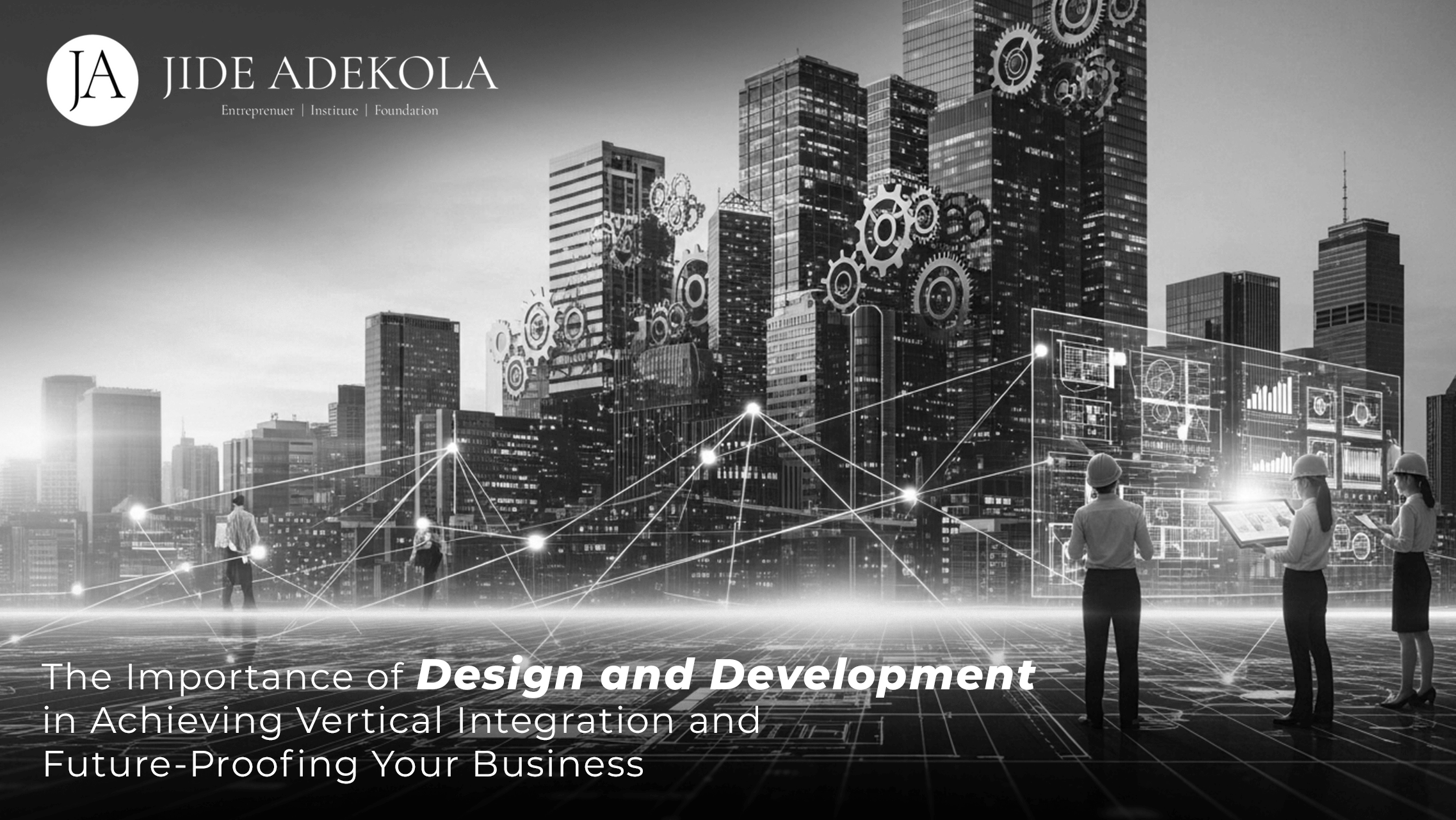
In an age where industries are rapidly evolving and market demands shift overnight; businesses can no longer rely on fragmented systems and short-term strategies. Success today depends on coherence and a seamless integration of every stage of production, from conception to execution. This is where design and development transcend their traditional roles and become strategic levers for achieving vertical integration and future-proofing a business.
Design and development are often perceived as creative or technical processes. But in truth, they are structural instruments, the blueprint and the scaffolding that allow a business to scale efficiently, control its value chain, and remain adaptable in uncertain futures.
The Role of Design in Vertical Integration
At its core, design is about intention. It defines not just how a product looks, but how a system works. When applied strategically, design becomes the framework that connects every element of an organization from procurement to production, distribution to customer experience under a single vision.
In architecture, the design process anticipates the flow of people, materials, and energy to create harmony within a space. Similarly, in business, design thinking helps establish a coherent operational flow that minimizes friction between departments or stages of production.
Design-driven vertical integration doesn’t just streamline operations; it enhances brand coherence. When every product or service emanates from a consistent design philosophy, the business gains identity, efficiency, and market distinction.
Development Strategies for Future-Proofing
If design is the vision, development is the execution. Development transforms conceptual thinking into operational capacity with the systems, technologies, and workflows that sustain long-term growth.
To future-proof a business, development strategies must evolve beyond traditional planning. Three methodologies stand out:
- Agile Development: This approach emphasizes adaptability. Instead of rigid long-term plans, agile structures allow for continuous feedback, rapid iteration, and flexibility in response to market changes.
- Iterative Development: Here, growth happens in cycles; prototype, test, refine, repeat. This ensures that products and systems improve continuously and remain relevant over time.
- Continuous Integration: Borrowed from software engineering, this principle advocates for constant merging of processes and systems, ensuring that the organization operates as a living ecosystem rather than a collection of silos.
These approaches create a resilient business model, one that thrives in uncertainty and transforms disruption into opportunity.
The Benefits of Vertical Integration
Vertical integration, when achieved through thoughtful design and development, provides businesses with a competitive edge that extends far beyond cost savings.
- Operational Efficiency: By owning or directly controlling various stages of production, companies reduce lead times, minimize supply chain risks, and improve turnaround.
- Cost Management: Integration eliminates intermediary margins and creates economies of scale.
- Quality Control: When production and delivery remain in-house, standards become consistent and traceable.
- Strategic Agility: An integrated system allows businesses to pivot faster a crucial advantage in volatile markets.
In essence, vertical integration aligns profit with purpose. It ensures that efficiency is not achieved at the expense of innovation or quality, but through them.
Designing for the Future
Future-proofing begins with foresight. The companies that will thrive in the coming decades are those designing systems, not just products systems that can evolve with technology, market demands, and societal needs.
In architecture, a building designed for longevity considers not just the present, but the adaptability of its spaces. Likewise, a business must design processes and infrastructures that can be repurposed, scaled, or transformed as the world changes.
Consider sustainability, for instance. It is no longer just an environmental ideal; it is a design imperative. Businesses that embed sustainability in materials, operations, and culture will naturally align with future regulations and consumer expectations.
In this context, design and development are not end goals; they are continuums of adaptation. They enable organizations to reimagine themselves repeatedly without losing their essence.
Vertical integration is not achieved merely by acquiring more control it is achieved by designing connection. And future-proofing is not just about predicting trends it is about building systems that can absorb them.
As an architect, I’ve learned that every structure whether physical or organizational must begin with a clear design intent and evolve through disciplined development. The same applies to business: the stronger the foundation, the more resilient the structure. In the intersection of design and development lies the blueprint for sustainable success. Businesses that master this intersection don’t just survive the future they shapeit.