
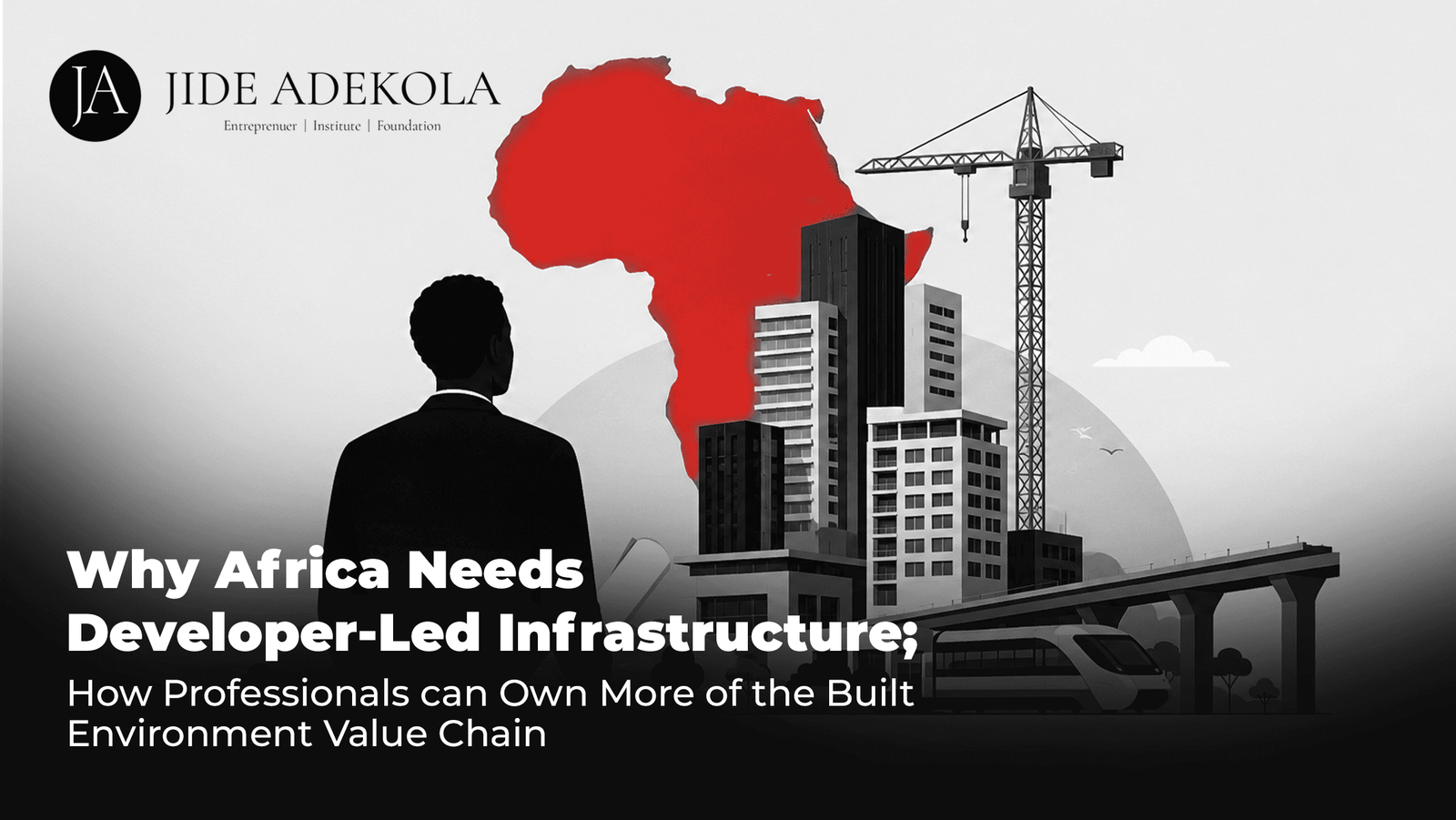
Every year, African cities absorb millions of new residents, yet the professionals best equipped to shape that growth architects, engineers, quantity surveyors, urban planners remain largely confined to the design table. We draw the buildings. Someone else finances them, develops them, and captures the value they create. It is time this changed.
Across Lagos, Nairobi, Accra, and Kigali, the built environment is expanding at a pace that outstrips almost any other region in the world. Yet the professionals who understand these cities most intimately who know the soil, the climate, the culture, and the constraints are rarely the ones who own the projects. Instead, capital tends to flow through developers with little technical grounding, financiers detached from the realities of construction, and, increasingly, foreign investors who see Africa’s infrastructure gap purely as an arbitrage opportunity. The result is a value chain where design professionals are paid a fee and development profits leave the room without them.
The cost of staying at the drawing board: When professionals limit themselves to design and supervision, they cede the most lucrative parts of the value chain: land acquisition, project financing, development management, and asset ownership. A quantity surveyor who prices a building may earn a fraction of a percent in fees, while the developer who owns the asset captures returns many multiples larger over the life of the project. This is not a criticism of developers it is a structural gap that technical professionals have been slow to close.
The irony is that no one is better positioned to develop than the people who already understand cost, structure, sequencing, and risk. What is missing is not competence. It is capital access, business literacy, and the confidence to move from service provider to principal.
What developer-led infrastructure looks like: Developer-led infrastructure simply means technical professionals stepping into ownership roles as co-developers, joint venture partners, or project sponsors rather than remaining purely as consultants. This can take several forms:
- Small-scale vertical integration: an architecture or engineering firm partnering with a landowner to develop a project, taking equity instead of, or alongside, a design fee.
- Professional-led development vehicles: groups of architects, engineers, and surveyors pooling expertise and modest capital to develop mid-sized housing or commercial schemes themselves.
- Technical partnerships with institutional capital: professionals bringing feasibility, cost, and delivery credibility to pension funds, diaspora investors, or development finance institutions that have capital but lack execution capacity on the ground.
None of these require professionals to become financiers overnight. They require a shift in posture from executing someone else’s vision to originating and structuring projects themselves.
Why now? Three forces make this moment particularly urgent.
- First, Africa’s infrastructure financing gap is estimated in the tens of billions of dollars annually, and much of that capital is actively looking for credible, technically sound partners to deploy through not just contractors to hire.
- Second, digital tools have lowered the barrier to feasibility modelling, cost estimation, and project structuring, meaning a small technical team can now do work that once required a large development company.
- Third, a new generation of African professionals is more mobile, better networked, and less willing to accept the traditional ceiling placed on design fees.
The professional’s responsibility: This shift will not happen by accident. It requires professional bodies to expand training beyond technical competence into development finance, land law, and investment structuring. It requires firms to build small balance sheets and take calculated equity positions rather than always trading time for fees. And it requires individual professionals to see themselves not only as service providers, but as potential owners of the value they help create.
Africa does not simply need more buildings, roads, and power infrastructure. It needs that infrastructure to be developed by people who understand it deeply and who have a long-term stake in its success. When professionals move from the margins of the value chain to its centre, the built environment stops being something Africa merely hosts, and becomes something Africa truly owns.