
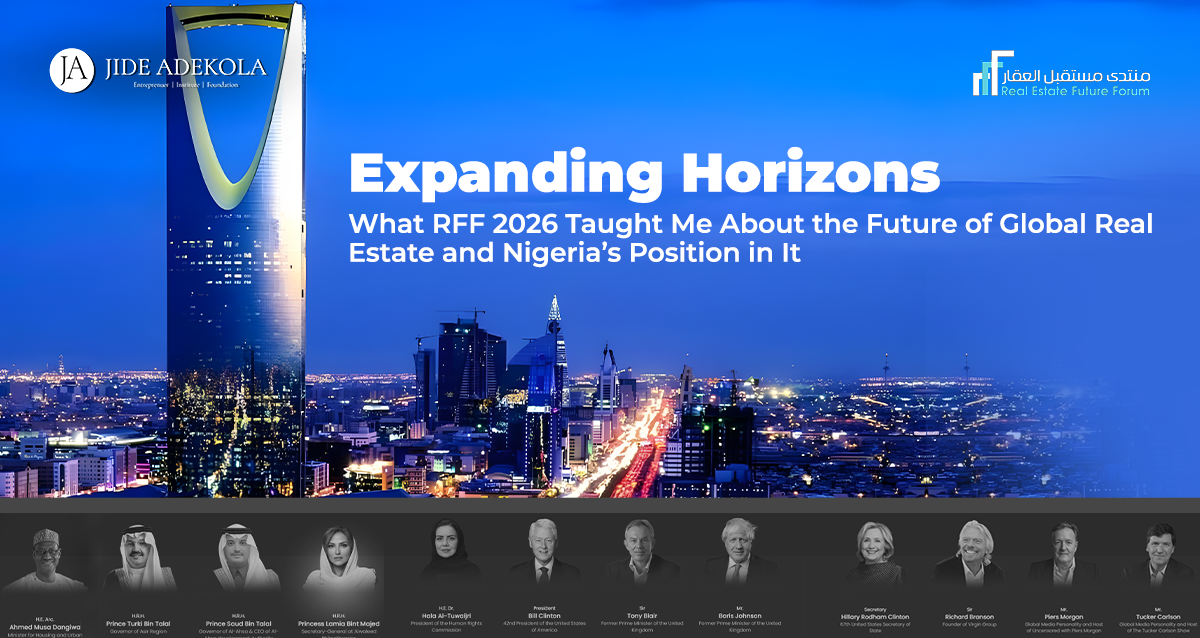
In January 2026, I had the privilege of attending and following the conversations emerging from the Real Estate Future Forum 2026 held in Riyadh. Convened under the theme “Expanding Horizons: Real Estate Thriving,” the forum brought together policymakers, developers, institutional investors and strategic advisors to interrogate one central question:
How do we make real estate markets more investable, more transparent, and more globally connected?
What emerged was not just a regional conversation. It was a blueprint for how serious markets attract serious capital.
As a business leader operating within frontier markets, I view RFF 2026 as more than an event. I see it as a signal a strategic inflection point in how regulation, capital mobility, and market structure are reshaping global real estate.
And for Nigeria, the implications are profound:
1. Legal Clarity Is Capital’s First Requirement: One of the defining highlights of the forum was the rollout of Law of Real Estate Ownership by Non-Saudis in Saudi Arabia. Fully implemented in January 2026, the law enables foreign individuals and corporate entities resident and non-resident to own property within designated zones under clearly articulated legal parameters.
This is not merely a policy adjustment. It is a structural shift. Global capital does not move based on sentiment. It moves based on clarity.
When foreign ownership laws are explicit, enforceable, and transparently administered, liquidity deepens. Risk perception narrows. Institutional participation increases. Over time, the entire asset class matures.
The lesson here is simple: regulatory maturity precedes capital scale.
For markets like Nigeria, this reinforces the urgency of strengthening title systems, land administration processes, dispute resolution mechanisms, and investor protection frameworks. Demand alone is not enough. Structure is what converts demand into bankable opportunity.
2. Capital Is Becoming Integrated Not Isolated: Another theme that stood out was the integration of capital flows across real estate, infrastructure, and debt markets. The conversations were not about standalone property transactions. They were about:
- REIT-style investment vehicles
- Fractional ownership models
- Blended finance structures
- Infrastructure-linked development strategies
This reflects a broader macroeconomic reality: real estate is increasingly viewed as part of a sophisticated portfolio allocation strategy, not merely a development play. Institutional investors today are looking for liquidity pathways, exit structures, governance standards, and performance transparency. They are asking:
- How does this asset integrate with infrastructure?
- What financing mechanisms reduce risk exposure?
- Is there secondary market depth?
These are the same questions Nigeria must consistently be prepared to answer.
At HomeWork Group, Africa our model has always recognized that real estate cannot exist in isolation. It must be evaluated through the lens of finance, structure, risk distribution, and long-term capital strategy.
3. Technology Is No Longer Optional It Is Foundational: RFF 2026 also reinforced something I strongly believe: digital infrastructure is now a core market infrastructure.
Prop-tech solutions, data transparency, digital registries, performance tracking dashboards, and green building benchmarks are no longer enhancements they are prerequisites.
Institutional investors assess markets based on data visibility.
They price risk based on transparency.
They allocate capital based on governance confidence.
For Nigeria, strengthening digital title registries, building verifiable transaction platforms, and ensuring transparent project pipelines will materially influence global capital decisions.
Technology reduces opacity.
Opacity increases perceived risk.
Perceived risk increases the cost of capital. The equation is straightforward.
4. What This Means for Nigeria: Nigeria’s participation in RFF 2026 signalled more than representation. It demonstrated intent to position housing and urban development as structured, reform-led, and investment-ready.
But representation must translate into execution. Nigeria possesses one of the largest housing gaps in Africa. That demand is real. It is measurable. It is urgent.
However, demand without disciplined delivery frameworks does not automatically translate to institutional investment.
To unlock scale, we must align three pillars:
- Regulatory Clarity: Clear, consistent, and enforceable property and investment laws.
- Structured Delivery: Risk-sharing frameworks between public and private sectors, backed by measurable milestones.
- Digital Transparency: Technology-driven systems that improve governance, tracking, and investor confidence.
When these three pillars align, housing shifts from being a social burden to becoming an investable asset class.
5. The Broader Signal to Global Investors: RFF 2026 reinforced a broader truth about frontier markets:
Capital is actively searching for scale but it demands structure. Markets that combine demographic strength, reform momentum, and institutional collaboration will increasingly attract long-term capital flows.
Nigeria has scale.
Nigeria has demand.
Nigeria has opportunity.
What we must consistently strengthen is structure.
If we align our reforms with global benchmarks as demonstrated by Saudi Arabia’s recent legislative clarity, we can position Nigeria not just as a high-demand market, but as a disciplined, investment-ready destination.
For me, the most important takeaway from RFF 2026 is this: Real estate growth in the next decade will not be defined by who builds the most.
It will be defined by who structures the best.
The markets that thrive will be those that combine policy reform, financial innovation, digital transparency, and disciplined execution.
Nigeria stands at that threshold. If we commit to regulatory maturity, integrated capital frameworks, and technology-driven governance, we will not simply participate in global real estate conversations we will shape them. And as leaders within this ecosystem, it is our responsibility to build not just projects, but platforms worthy of global capital.